The fashion industry has always been an active sector in the global economy; it has continued to change to adapt to other changes in the market such as preferences, fashion, and technology.
With fast fashion on the rise to sustainability, changes in the fashion world have not gone unnoticed for quite some time now.
In the current century, two technologies are central to defining the future of the industry and these are AI and Blockchain.
AI and blockchain are becoming powerful tools that are revolutionizing the way that fashion brands work and interact with consumers.
AI is enhancing companies’ ability to deliver targeted interactions predict trends in the market, and provide customized goods; at the same time, blockchain is creating trustful and transparent supply chains. Such technologies are increasing the interactivity, efficiency, and consumer orientation of fashion.
Let’s explore and look at how AI and blockchain are reshaping the fashion industry.

The Role of AI in Fashion
Artificial Intelligence (AI) has gradually entered the fashion industry and is growing more popular.
Be it in the formulation of new collections, in the adaptation of the shopping experience, or plenty of other areas, AI is changing fashion.
Now let’s consider 4 major areas that prove how Artificial Intelligence is being applied.
A) AI in Design and Trend Prediction
- AI is useful for designers in that it allows them to get ready for new trends based on data analysis.
- Through analyzing historical data, consumer habits, and social media insights, AI may determine what types of styles, colors, and materials will be more desirable in the future.
- For such a case, an AI solution like Heuritech uses data analytics to predict trends in the market.
- These tools monitor several million photos and mentions on social media to identify trends in what people wear and discuss so that designers can bring products to market that will be popular.
- This in turn helps fashion brands come up with better decisions as to what to design and develop.
B) Personalization of Customer Experiences
- Another of the most interesting applications of AI in the fashion industry is to make the process of shopping more private.
- This is where AI comes in and provides a platform where brands get to suggest the next product to buy through your consumption patterns, history, and likes.
- AI brought forward virtual stylists and with the help of these tools, you can select an outfit or accessory that you like.
- For such a case, Farfetch and ASOS sale apps are to their customers’ relevant products that the buyer is likely to purchase.
- This makes online shopping more enjoyable and saves time because customers get what he or she wants without having to spend time browsing.
C) Virtual Try-Ons and Augmented Reality (AR)
- Accessory in clothing has always been necessary at the time of purchasing clothes but since the trend of online shopping has shifted so much, it becomes a bit difficult.
- That is where AI and Augmented Reality (AR) play the role of fitting rooms without actually purchasing clothes.
- Prada in its virtual fitting application offers shoes or accessories to try on virtually to see how it will look and fit.
- This feature makes shopping through the website more secure by helping clients make wiser decisions.
D) AI and Sustainability in Fashion
- The topic of sustainability is becoming more and more relevant in the fashion industry and AI contributes to the change in this sector.
- It helps brands to determine the precise quantities of the materials to use in production while cutting down the wastage.
- For example, AI will enable the forecast of fabric choices and design patterns to help in the development of sustainable fabrics.
- It can also be used in forecasting situations that may lead to material shortages and also be of assistance to designers in decision-making that will help cut down on wastage and energy consumption.
- This also makes brands reduce wastage and make the right decisions on what to develop hence promoting sustainable fashion.
The Role of Blockchain in Fashion
Blockchain technology, which is most famously used in the world of cryptocurrencies, is also impacting the fashion industry.
It offers solutions to some of the biggest challenges the industry has to face such as the issue of authenticity, transparency, and supply chain management.
Now let’s look at how blockchain technology is changing the fashion industry.
A) Blockchain for Traceability and Transparency
One of the key benefits of using blockchain in fashion as it helps to track the origin of fashion products.
As such customers and brands can trace the journey of a product from the inputs to the output level.
This keeps the item original and bought legally from any middlemen or unauthorized persons.
Gucci and Prada have associated with AURA Blockchain to guarantee the legitimacy of their products.
By using blockchain, a customer will be assured that the product they are using is original, not fake, and has been produced legally.
Such high levels of transparency help to create trust between brands and consumers to help in fighting the growth of fake products within the fashion industry.
B) NFTs and Digital Wearables
Blockchain has created new possibilities for fashion and digital fashion assets are considered valuable and meaningful.
NFTs (Non-Fungible Tokens), are tokens that provide evidence that someone owns a unique item.
In fashion, blockchain is used to generate NFTs associated with virtual garments and accessories, including clothing and accessories. These devices can be worn as avatars in virtual reality or shared on social media platforms.
Luxury fashion brands Dolce & Gabbana teamed up with digital fashion marketplace UNXD to launch its own NFT collection.
These fashion items are also sale objects that can be bought, sold, or exchanged through an online platform; such items are the future of fashion, particularly in virtual and augmented reality.
C) Blockchain in Supply Chain Management
A third positive effect of blockchain in fashion is enhanced supply chain clarity.
It makes it possible for organizations to track in the supply chain to have an independent decentralized ledger.
This makes it easier for brands to be guaranteed that their products are being produced under fair and ethical standards.
For example, Everledger includes blockchain for the tracing of diamonds and other valuable possessions to verify that there is no violence or unlawful business in the chain.
In fashion, blockchain can minimize counterfeits and improve manufacturing traceability since firms can track the origin of every product.
These enable better and more responsible approaches towards the fashion business.
D) Smart Contracts and Payments
Similarly, smart contracts can be applied in a fashion to simplify financial operations in the chain.
A smart contract is an intelligent contract involving two or more parties, which self-executes on occurrence of certain conditions.
This technology can boost the payment process and build the credibility of the transaction for a smaller amount.
In fashion, smart contracts can help brands and customers make safe and secure payments for the products they want to buy and sell without the presence of an intermediary.
This is especially the case where micro-payments for digital fashion are being made; amounts of money are likely to be small.
The beauty of blockchain is that these transactions are secure, and swift and are not linked with any kind of fraud.
Benefits of AI and Blockchain for Brands
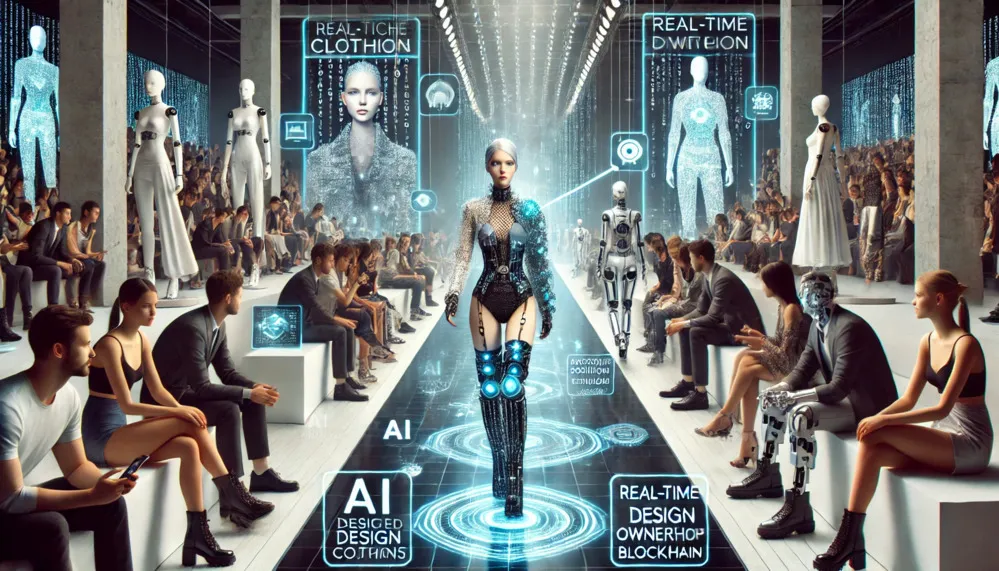
These tools not only make businesses operate efficiently but also allow them to meet their customers, identify and exploit available opportunities, and transform into sustainable business operations.
1. Increased Efficiency and Cost Savings
- AI and blockchain help fashion businesses to become more effective and productive because they decrease the amount of necessary work.
- AI tools can detect the likely demand patterns of products, improve stock, and cut excess stock.
- In the same way, blockchain offers supply chain transparency; people can quickly locate products and avoid purchasing items from irresponsible sources.
- Due to the minimization of the above gaps, these technologies allow brands to cut costs.
- For example, less returns and wastage can be costly hence reducing the costs may be used to fund other aspects of a business such as the design and marketing.
2. Enhanced Customer Engagement and Loyalty
- AI and blockchain help brands enhance the relationships they have with their consumers.
- Personalized shopping services mean buyers receive customized shopping experiences based on their tastes and preferences since the process is controlled by powerful artificial intelligent algorithms.
- Blockchain provides another line of defense because it guarantees that the products being sold are real and made without violating human rights.
- Customers love businesses that hold transparency, especially when it comes to their needs and best interests and they stick with that brand.
- Personalization boosts customer interaction while transparency also enhances the interactions hence boosting customer engagement.
3. Access to New Revenue Streams
- There is a possibility to diversify the revenue model and experiment with the new ones this case brings through NFTs and digital fashion.
- This is illustrated by products such as limited NFT copies that give a product the exclusiveness that is favored by modern tech-savvy customers.
- Companies such as Dolce & Gabbana have witnessed success in launching their NFT collections and getting a lot of returns with their clients getting a different experience.
- Through the use of digital fashion, brands can be able to reach out to more people through the markets
4. Improved Sustainability Practices
- Sustainability is a big issue in the fashion industry and, here, AI and blockchain function as a solution.
- AI supports brands to create sustainable products by predicting the amount of material required and reducing the amount of material that is wasted.
- Blockchain is useful for checking the brands’ activities when sourcing and manufacturing products, guaranteeing that they are ethical and sustainable.
- These technologies help brands to meet consumers’ need for sustainable fashion options.
Benefits for Consumers
1. Personalized Shopping Experiences
AI improves online shopping as it will take into consideration your preferences and suggest the best products for you.
Instead of browsing through pages, you are given recommendations of items that you like, and since shopping is more efficient and fun.
2. Trust and Transparency
Blockchain helps to guarantee that only high-quality, genuine, and fairly produced fashion items get to the market.
It follows the path of products from production until the point of purchase ensuring that you receive quality and genuine products.
Such openness provides confidence and tranquility to the consumers.
3. Access to Exclusive Digital Fashion
Blockchain can lead to the creation of NFTs, and customers can own exclusive digital fashion products such as clothes or accessories.
This exclusive wearable can be showcased online or in virtual spaces which gives a new dimension to modernity and innovation in fashion.
4. Reduced Environmental Impact
Both AI and blockchain help in the efficient use of resources while encouraging the use of environment-friendly resources.
AI improves production operations, and blockchain allows consumers to be sure that their products are made with the necessary attention to the consequences of the production process.
Challenges of AI and Blockchain Integration
Despite all the opportunities that AI and blockchain open in the fashion industry, their implementation program has certain difficulties.
1. Scalability Issues
Currently, scaling is a common challenge affecting blockchain systems and thus implementing these solutions in the fashion industry worldwide is challenging.
Managing huge volumes of data like supply chain information or an even NFT transaction takes infrastructure that many organizations have not created yet.
2. Adoption Resistance and Education
Legacy fashion brands may not resist AI and blockchain technologies simply because they are not well acquainted with either of the platforms.
A lot of companies will not invest in innovation when there is no return on investment immediately, and other brands are restricted by size and funds to try out these applications.
Despite these advantages, the diffusion of these technologies requires educated industry leaders to promote the advantages of adopting them.
3. Data Privacy Concerns
When it comes to using AI, the problem of privacy arises because AI is based on the analysis of customer data.
Customers may be concerned about how their information is collected, processed used, or even distributed.
Also, blockchain even though secure needs strong ways to enhance security to protect important data, especially for customer-facing apps.
4. Regulatory Hurdles
It is also worth mentioning that today regulation of the blockchain and AI is different in other countries, and this is an additional factor in international application.
Some of the concerns that companies have about NFTs include legal ownership of such tokens, rights issues, and taxation of digital goods can slow brands’ adoption of these technologies.
The Future of AI and Blockchain in Fashion
A) New Brands and Building Consumer Trust
In the future, AI is expected to be the major driver for fashion democratization as younger brands will be able to use modern tools for design and trend predictions, as well as for effective customer relations management.
This will help new talents to match up with famous designers while increasing the popularity of a diverse market.
Blockchain will increase transparency and trust and offer consumers access to certified sustainably sourced products; they will build loyalty between generations.
B) Metaverse, Virtual Fashion, and Sustainability
Other tendencies, namely the increasing popularity of the metaverse and virtual presentations of collections, will only add to it.
Over the next few years, customers might buy clothes for their virtual avatars with accessories that are authenticated by blockchain technology.
Sustainable product designs will also be promoted through the use of AI techniques whereby brands will design environmentally conscious clothes that meet the customers’ choices.
C) Transforming Fashion with AI, Blockchain, and Innovation
The combination of these technologies can shape the innovation of the consumer encounter as one that is customized, integrated, and exceptionally engaging.
From smart personalization of clothing storage and artificial intelligence-based wardrobes to the use of blockchain in creating and selling limited edition NFTs, the fashion industry will not only move forward but can grow in a post-pandemic connected world.
This integration signals a future of technologies and creative thinking to transform fashion and its perception.
Bottom Line
AI alongside blockchain is revolutionizing the fashion industry through personalization, transparency as well as sustainable measures.
These technologies are very interesting with the potential to create new opportunities for brands and consumers.
These changes will define the further development of fashion and contribute to the creation of a world that is more interconnected and sustainable.