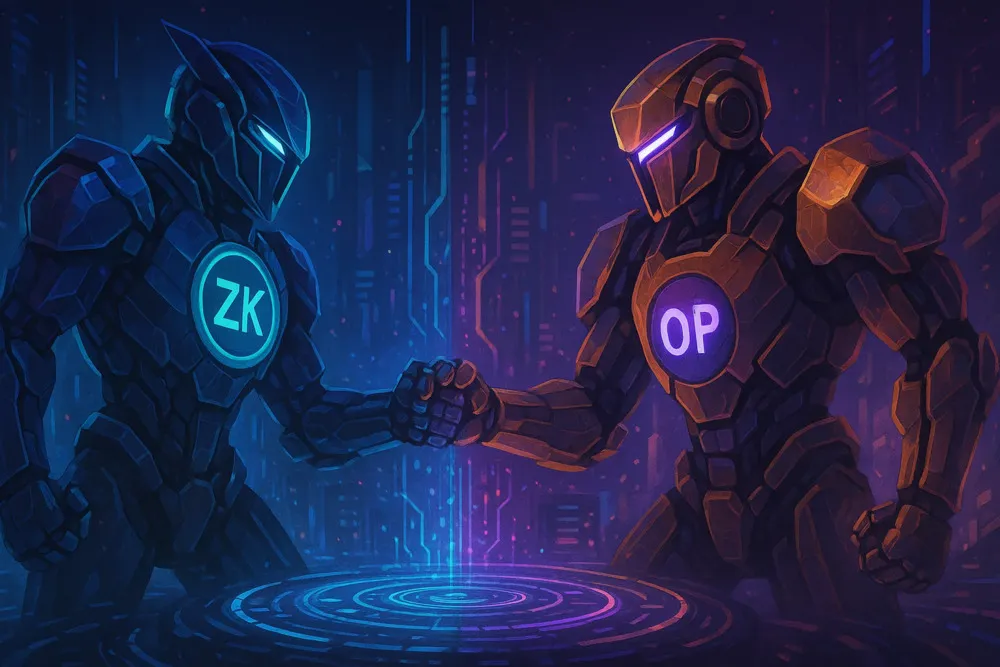
Ethereum’s explosive growth into the preeminent smart-contract platform has demonstrated the potential behind decentralized applications, decentralized finance (DeFi), and tokenized assets. But it has also exposed an Achilles’ heel: scalability becomes a real problem as more users clog the network, transaction fees soar, and confirmation times expand. The situation soon gets prohibitively expensive and slow for the average user looking to trade tokens, mint NFTs, or play dApps.
This is where Layer 2 (L2) scaling solutions come in. Layer 2 solutions are protocols built on top of Ethereum to handle transaction processing outside of the overburdened “main chain” (Layer 1) while still benefiting from the security and decentralization of that main chain. Among these, rollups have emerged as the standout approach. By bundling (“rolling up”) hundreds or thousands of transactions into a single proof or batch, rollups achieve dramatic throughput gains and cost savings.
Within the rollup category, two architectures dominate the conversation:
- Optimistic Rollups: Trust-but-verify systems that assume transactions are valid unless challenged.
- Zero-Knowledge (ZK) Rollups: Cryptographic constructions that produce proofs that each batch of transactions is correct.
Which of these will come out ahead in the race to scale Ethereum? The fact is, they are both quite strong, and each has its weaknesses. In this post, we’ll cover:
- How L2s scale Ethereum
- Key differences between ZK Rollups and Optimistic Rollups
- Current market leaders
- Pros and cons for users and developers
- Emerging trends in L2 interoperability
And by the end, you’ll have a nuanced frame of where rollups are today and where rollups are headed tomorrow.
How L2s Scale Ethereum
1.1 The Scalability Trilemma
Security and Decentralization are at the Core of Ethereum’s Design. Every node in the network validates and records each transaction. This model works wonders for trustlessness but limits throughput to around 15 transactions per second (TPS). In contrast, centralized systems like Visa can handle tens of thousands of TPS.
Ethereum co-founder Vitalik Buterin framed this as the “scalability trilemma”: protocols can optimize for two out of three properties—security, decentralization, and scalability—but not all three simultaneously. Layer 2 solutions stretch this boundary by pushing large portions of computation off-chain while anchoring security to Ethereum’s settlement layer.
1.2 Categories of Layer 2 Solutions
Broadly speaking, L2 approaches fall into several buckets:
- State Channels (e.g., Raiden, Celer): 2 participants or more open a channel, take all the transactions off-chain, and settle the final state back on the Ethereum blockchain.
- Sidechains (Polygon PoS) – Separate blockchains that have their consensus mechanism and, from time to time, anchor checkpoints to Ethereum. Offer high throughput but rely on a separate validator set.
- Plasma (e.g., OMG Network): Tree-like structures that commit Merkle roots to Ethereum, enabling fraud proofs to exit bad actors. Largely supplanted by rollups.
- Rollups: Aggregate transactions into chunks and publish small proofs or summaries to Ethereum. Optimize the trade-offs between cost, security, and developer ergonomics.
1.3 Why Rollups Shine
Rollups inherit Ethereum’s security because each batch is ultimately secured by the L1 consensus. They dramatically reduce gas costs by amortizing fees across many transactions. Depending on design, they can deliver 100× to 1,000× improvements in throughput and fee reduction.
Key attributes:
- Security: All transactions, or their proofs, are recorded on Ethereum.
- Cost Efficiency: Shared data and proofs drastically cut per-transaction gas.
- Decentralization: Many rollups maintain open validator sets and support user-run nodes.
- Compatibility: EVM-compatible rollups let existing smart contracts and tooling port easily.
Two rollup families have ascended to prominence:
- Optimistic Rollups
- Zero-Knowledge (ZK) Rollups
Each tackles off-chain computation and on-chain settlement differently, leading to distinct trade-offs.
Differences Between ZK Rollups and Optimistic Rollups
2.1 Core Philosophy
| Aspect | Optimistic Rollups | ZK Rollups |
| Trust Model | Assumes correctness; disputes handled post hoc | Cryptographically proves correctness upfront |
| Finality | Delayed until the challenge period elapses | Immediately upon proof verification |
| Security Liveness | Relies on watchers to monitor fraud | No reliance on off-chain watchers |
| Complexity | Simpler proofs, more onus on economic incentives | Sophisticated cryptography, heavier prover work |
Optimistic Rollups: “Trust, Then Verify”
- Workflow:
- Users submit transactions to the rollup sequencer.
- Sequencer orders and bundles them into batches.
- Batch data and state root are posted to Ethereum with minimal on-chain checks.
- A challenge window (commonly 7 days) opens for anyone to submit a fraud proof if they spot an invalid state transition.
- If no fraud proof emerges, the batch is finalized; if fraud is proven, the invalid batch is rolled back.
Advantages:
- General-purpose computation: Virtually any EVM logic runs unmodified.
- Lightweight proofs: Fraud proofs are smaller and faster to produce, even for complex contracts.
- Limitations:
- Withdrawal delays: Users must wait out the challenge period (often 1 week) to move assets back to L1.
- Security depends on “watchers”: If no one monitors the chain, bad batches slip through. Economic incentives (bonds, slashing) help, but risk remains.
ZK Rollups: “Prove, Don’t Trust”
- Workflow:
- Transactions are executed off-chain to update the rollup’s state.
- A zero-knowledge proof (SNARK or STARK) is generated, attesting that the state transition is valid.
- The proof and minimal calldata (e.g., new state root, account diffs) are submitted on Ethereum.
- Ethereum’s verifier contract checks the proof; if valid, the batch is instantly accepted.
- Advantages:
- Instant finality: No waiting for fraud windows; funds can be withdrawn in minutes.
- Robust security: Mathematical guarantees eliminate the need for watchers.
- Lower on-chain data: Many ZK schemes compress calldata efficiently.
- Limitations:
- Prover overhead: Generating proofs (especially STARKs) demands significant compute and time.
- Circuit constraints: Complex logic must be expressed in specialized constraint systems, adding dev complexity.
- EVM compatibility gaps: Early ZK rollups required custom languages (e.g., Cairo), though EVM-compatible ZK toolkits are emerging.
2.2 Performance & Cost
| Metric | Optimistic Rollups | ZK Rollups |
| Typical Throughput | ~100–500 TPS | ~500–2,000 TPS |
| Batch Posting Gas Cost | Low (no proof) | Higher (proof verification cost) |
| Per-Tx Fee | Low (amortized) | Very low (efficient proofs) |
| Withdrawal Time | Days (challenge period) | Minutes–hours |
- Gas Costs:
- Optimistic rollups post calldata uncompressed; ZK rollups often compress calldata or post proofs only.
- ZK proof verification consumes gas but is offset by reduced calldata and fewer on-chain operations.
- User Experience:
- ZK rollups offer near-instant exit, improving UX for DeFi and gaming.
- Optimistic rollups require users to trust bridges that may provide “fast exits” by fronting liquidity (at extra cost) and settling later on L1.

Current Leaders (e.g., Arbitrum, Optimism vs zkSync, Starknet)
The rollup ecosystem is dynamic. Teams are racing to improve performance, lower costs, and onboard developers. Let’s spotlight the current frontrunners.
3.1 Optimistic Rollups
Arbitrum (Offchain Labs)
- Launch: August 2021
- Ecosystem Highlights: Over $3 billion TVL across DeFi (Uniswap v3, SushiSwap), NFT marketplaces, and gaming.
- Technical Edge: Arbitrum One offers near-EVM parity using the Arbitrum Virtual Machine (AVM).
- Roadmap: Arbitrum Orbit allows custom rollup chains; Arbitrum Stylus integrates Rust/WASM support.
Optimism (OP Labs)
- Launch: June 2021 (Mainnet)
- Ecosystem Highlights: 2 billion+ TVL, deep integration with Synthetix, Chainlink, and a strong Dev grant program.
- Technical Edge: OP Stack — a modular L2 toolkit for Optimism, Base (Coinbase’s L2), and other OP-compatible chains.
- Governance & Funding: Retroactive Public Goods Funding (RPGF) channels incentives to projects that strengthen the ecosystem.
3.2 ZK Rollups
zkSync Era (Matter Labs)
- Launch: Mainnet Beta in March 2023
- Ecosystem Highlights: Growing DeFi hubs (Curve, Balancer), NFT support (Mintbase), and an SDK for cross-chain bridges.
- Technical Edge: zkSync’s Zinc compiler makes ZK circuits accessible to Solidity devs with minimal changes.
- Roadmap: zkPorter integration for data-availability scaling, zkEVM developer tooling, and modular ZK Stack.
Starknet (StarkWare)
- Launch: Mainnet Alpha, November 2021
- Ecosystem News: Powers dYdX v4, Immutable X, Sorare, DeversiFi.
- Technical Edge: Transparent (no trusted setup) quantum-safe STARK proofs and scalability that surpasses most other blockchains.
- Roadmap: Cairo V2 simplifies smart contract dev; Warp compiler bridges Solidity to Cairo.
3.3 Comparative Adoption
| Rollup | TVL (approx.) | Number of dApps | Avg. TPS | Mainnet Status |
| Arbitrum One | $3 B | 120+ | ~200 | Production |
| Optimism | $2 B | 80+ | ~150 | Production |
| zkSync Era | $1.2 B | 60+ | ~400 | Beta / Production |
| Starknet | $1.5 B | 50+ | ~300 | Alpha / Production |
Pros and Cons for Users and Developers (≈600 words)
4.1 User Perspective
| Factor | Optimistic Rollups | ZK Rollups |
| Transaction Fees | Low | Very low |
| Withdrawal Times | 1–7 days (can use liquidity bridges) | Minutes–hours |
| Security Model | Fraud proofs rely on watchers | Succinct proofs; strong crypto basis |
| UX Maturity | Established wallets, bridges, and tools | Rapidly improving; some custom tooling |
| Bridge Availability | Many bridges, some risky | Fewer but increasing, more secure |
| Use Cases | DeFi heavy, general dApps | High-frequency trading, gaming, and privacy |
- Fees & Speed:
- ZK rollup fees tend to be slightly lower per tx due to compressed calldata, but proof generation costs factor in.
- Optimistic rollups can offer immediate “fast exits” via liquidity bridge providers, at an extra fee.
- Security Assurance:
- Users on ZK rollups enjoy mathematically guaranteed finality—no waiting, no trust in watchers.
- Optimistic rollup users lean on the network of watchers; major chains subsidize watchers’ infrastructure to avoid fraud slip-through.
- UX Considerations:
- MetaMask, Rainbow, and WalletConnect already offer native support for Arbitrum and Optimism, for instance.
- ZK-native wallets (e.g., Argent, zkSync Wallet) are maturing; the browser extension / mobile experience is broadening.
4.2 Developer Perspective
| Factor | Optimistic Rollups | ZK Rollups |
| EVM Compatibility | Near-perfect | Improving—zkEVM on the way |
| Language Support | Solidity, Vyper, EVM toolchain | Solidity via Zinc, Cairo, new compilers |
| Tooling & SDKs | Truffle, Hardhat, Foundry | zkSync SDK, StarkWare CLI, Warp |
| Complex Contract Logic | Fully supported | Some patterns need redesign |
| Dev Community | Large, mature | Growing, innovative |
| Runtime Costs | Lower provider costs | Higher prover costs, offset by lower calldata |
- Deployment:
- Porting an existing Solidity dApp to Arbitrum or Optimism is often a one-line config change in Hardhat or Foundry.
- Deploying on zkSync Era currently involves experimenting with Zinc or waiting for full zkEVM support, though that gap is closing rapidly.
- Debugging & Testing:
- Optimistic rollup environments are close replicas of the Ethereum mainnet, so existing testnets (Goerli, Sepolia) and dev tools work out of the box.
- ZK environments sometimes require specialized test frameworks to simulate proof generation locally, adding friction for small teams.
- Gas & Storage:
- Both rollup types significantly reduce gas costs, but developers must optimize calldata usage, especially on optimistic chains where calldata is uncompressed.
- ZK rollups permit creative on-chain data schemas, but developers must consider proof circuit size limits.

Trends in L2 Interoperability
As the Layer 2 ecosystem fragments into multiple rollup flavors, interoperability becomes crucial. Users and assets need frictionless movement across chains to avoid liquidity silos.
5.1 Cross-Rollup Bridges
Projects like Hop Protocol, Synapse, and Across have stepped in to offer cross-L2 bridges. They lock assets on one rollup and mint pegged tokens on another, often backed by liquidity pools to minimize wait times.
- Challenges:
- Security: Bridges might increase the attack surface if they rely on multi-signature or cross-chain validation.
- Finality Mismatches: Bridging from a chain with instant finality (ZK) to one with delay (Optimistic) requires careful design to avoid premature exits.
5.2 Shared Sequencers & Data Availability
Innovations like Espresso and Astria propose shared sequencers that process transactions for multiple rollups in a unified queue. This:
- Reduces MEV (Maximal Extractable Value) extracted by competing sequencers.
- Harmonizes transaction ordering across L2s.
- Improves composability for cross-rollup dApps.
Data availability solutions—such as Celestia or EigenDA—offer rollups a dedicated data layer, decoupling sequencing from data publication. Rollups can then piggyback on a common DA network, enhancing trust and simplifying bridging.
5.3 Modular “Stack” Architectures
- OP Stack (Optimism): A template for building purpose-specific rollups with plug-and-play modules for settlement, sequencing, fraud proofs, governance, and SDKs.
- ZK Stack (zkSync): A roadmap for architecting z-powered chains, from prover infrastructure to DA layers and interoperable bridges.
These stacks foster standardization, reducing integration time and enabling rollups to share core components, thereby smoothing interop.
5.4 User Experience Abstractions
Wallet-level innovations (e.g., Biconomy, Gelato) abstract away multi-chain complexity. Gas-paid accounts, paymasters, and subscription models allow users to interact with any L2 without needing to bridge or hold multiple tokens manually.
Conclusion
Then, who comes out on top of the L2 race, ZK Rollups or Optimistic Rollups? The fact is, it’s not a one-size-fits-all response. Both tech stacks have evolved and provide for varied use-cases within Ethereum’s expanding ecosystem.
Optimistic Rollups have done a great job of making Layer 2 more accessible. They’re easier to develop on, work well with existing Ethereum tools, and have already seen strong adoption thanks to projects like Arbitrum and Optimism. However, the trade-off comes with longer withdrawal times and the need for “watchers” to detect any potential fraud, which may not sit well with every user.
ZK Rollups, meanwhile, are the more technically advanced cousin. They use state-of-the-art cryptography to deliver quicker withdrawals and more security, which is really attractive to the likes of gaming, trading, and any service that is reliant on speed and low latency. That said, they’re still catching up when it comes to developer support and EVM compatibility—but they’re moving fast.
At the end of the day, it’s not about which is better in general, but which is better for your specific use case. Ethereum is big enough for both to thrive, and in fact, the future likely involves both types working side-by-side. With tools like cross-rollup bridges, shared sequencers, and modular stacks coming into play, we’re moving toward a more connected and user-friendly L2 experience overall.
Whether you’re a developer, investor, or just someone curious about Ethereum’s future, one thing is clear: Layer 2 isn’t just a trend, it’s becoming the foundation for the next chapter of Web3.