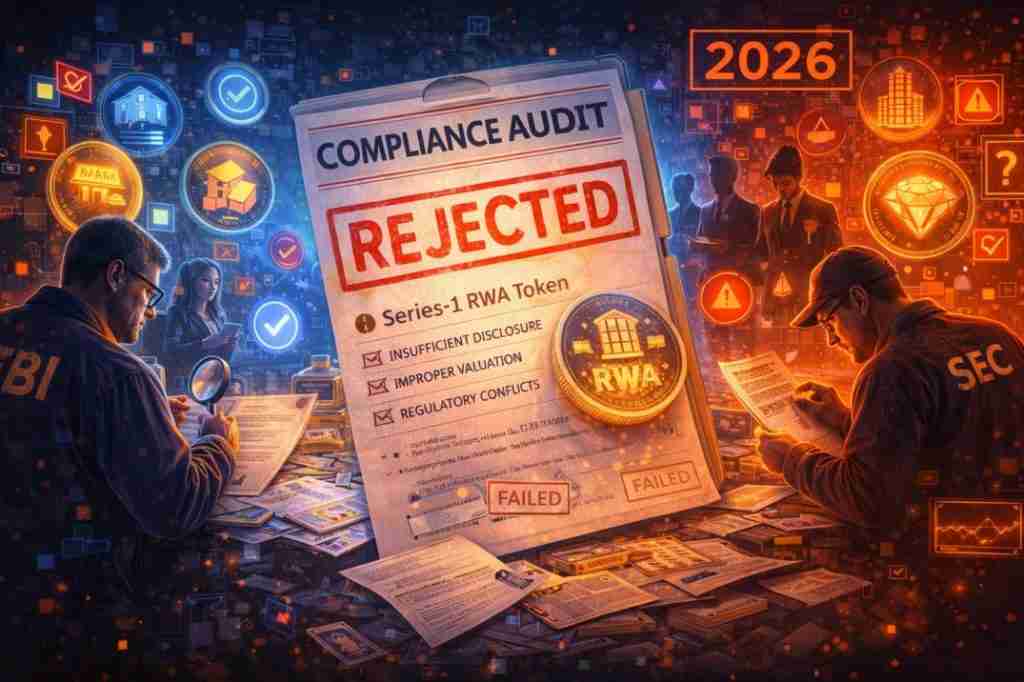
Most tokenized real-world assets will fail 2026 compliance audits because they grant only economic exposure through a special-purpose vehicle, not real legal title to the underlying asset. Tokenized real-world assets have been hailed as the most pragmatic bridges to access decentralized finance and traditional capital markets. The premise is simple: Take property rights, bonds, invoices, commodities, and any other tangible claims and turn them into digital tokens so that they can be divided up, traded, and used all around the world.
It is a powerful and perhaps inevitable idea, but the transition from paper and registries to ledgers demands scrupulous legal, operational, and compliance work. The early RWA projects looked at product-market fit and user experience, and missed out on the legal detail, which forms the foundation of asset-backed finance. This article explains why most RWA tokens that exist today are likely to fail compliance audits in 2026 and what foundational weaknesses auditors will expose.
The Legal Time Bomb: Why 70% of RWA Tokens Aren’t Backed by Real Assets.
If a project claims that it throws something up against a real asset, then the claim seems simple enough and cool. The buyer assumes that clear ownership exists, transfer equals title, and the token is a secure claim. In practice, the legal structures behind many tokenized assets are fragile.
A common model is to route assets through a special-purpose vehicle or trust and to mint tokens that represent economic exposure to that intermediary. Financial interest is a right to some or all of the property and its benefits, as opposed to merely owning it.
The difference is enormous for investors because the legal title determines enforceability, priority in insolvency, and their ability to secure value in disputes. Auditors investigate if tokens can represent legal rights, if security interests are perfected under any applicable laws, and whether the chain of title is recorded in established registries.
Projects without the ability to develop a clean chain of title, or which are built on a promise of payment in an untrustworthy world of contract law, will fail to be compliant with audit standards.
Jurisdictional mismatches are also common.
The asset might be physically located in one country, the legal owner registered in another, and the issuer incorporated elsewhere. This fragmentation has complicated who is to use what laws will apply to transfers, which registries need to be updated, and which courts can adjudicate rights. Again, auditors will not rely on token-based proof of ownership; they need documented filings and sealed documents, and custody confirmations from appropriate agencies.
Where those documents are absent or inconsistent, auditors will determine that the asset backing is insufficient. Custody arrangements further complicate matters. When related parties or unregulated entities control custody, the risk of theft escalates, and auditors will immediately highlight it as noncompliance.
Finally, valuations and liquidity claims are scrutinized. Projects often promise continuous secondary market liquidity or rely on optimistic appraisals. Auditors will demand independent valuations, clear methods of appraisal, and stress tests showing how tokens can be redeemed or liquidated in times of distress.
Tokens without documented appraisal regimes and liquidity backstops will fail on financial grounds in an audit. These legal, custody, and valuation gaps form a time bomb that will be detonated during comprehensive compliance reviews.
To be concrete, auditors will demand documentary evidence such as deed records, mortgage ledgers, lien searches, and registered security filings. They will request copies of warranties, insurance policies, and independent confirmation of asset possession.
If the asset is a loan portfolio, auditors will test sample accounts to ensure loans exist, payments are current, and that the SPV has unambiguous collection rights. Many projects rely on representations from related parties rather than independent confirmation, and those representations are rarely sufficient when exposure is tested under legal scrutiny.
Investors frequently assume that audit statements or third-party attestations suffice, but auditors will evaluate the independence and rigor of those attestations. Anonymous attestation from a non-accredited valuation firm or unaudited internal statements will be inadequate. Independence of appraisers, frequency of valuation, and documented governance for valuation disputes will all be factors in whether an auditor can accept a token’s claim of being asset-backed.

KYC/AML & Ownership: The Compliance Rules RWA Projects Are Ignoring.
Tokenization can be highly efficient, but it still sits inside the global financial system and must obey anti-money laundering and sanctions rules. Many RWA projects treat KYC as a one-time onboarding task and then allow unrestricted transfers on secondary markets. When a token represents regulated financial exposure, this design is inadequate.
Regulators and auditors expect ongoing monitoring of beneficial ownership, not merely a snapshot at the time of purchase. If tokens can be transferred between anonymous addresses, wrapped in DeFi primitives, or bridged across chains without an identity check, the connection linking the economic claim to a human provenance gets broken. Auditors will be looking for systems that can tie on-chain balances back to off-chain identities and prove they can identify the ultimate beneficiary.
Sanctions compliance is non-negotiable. Woolly answers will not suffice: tokenized assets that let sanctioned entities derive benefits from them, or are simply used as a covert value transfer through obscure conduits, are going to get hammered.
Auditors will test transaction histories and probe whether projects can freeze or claw back assets linked to illicit actors. Where projects lack practical mechanisms to enforce sanctions compliance, regulators will treat them as conduits for illicit finance.
Tax compliance is another area where many projects fall short. Tokenized yields and capital gains trigger reporting and withholding obligations. Auditors will assess whether issuers provide accurate tax reporting and whether they have taken reserves for potential liabilities. Failure to supply reliable, auditable tax records is a compliance failure that can result in back taxes and penalties.
Auditors will also verify whether transfer restrictions are embedded into the token mechanics and whether those restrictions are effective. Some projects embed on-chain transfer controls to prevent transfers to non-verified addresses, but implementation errors, interoperability with other protocols, and lax bridge mechanisms can circumvent these controls.
Auditors will test transfer flows end-to-end and will instrument scenarios where tokens move through multiple protocols. The presence of transfer controls on paper is insufficient if they can be bypassed in practice.
And last, KYC/AML programs should have governance: policies, trained individuals, audit trails, and escalation. Regulators also consider more than automated checks; they look at whether a project can answer suspicious activity reports, how it collaborates with law enforcement, and how robust its recordkeeping is as time passes. If you approach compliance as something to check off and not work towards every day, that’s a project that will fail on the audit line.
Beneficial ownership transparency is the final and critical component. Regulators will insist on documentation showing who ultimately benefits from an asset’s cash flows, including corporate ownership charts, trust deeds, and certifications from custodians. Entities whose eventual ultimate beneficiaries are hidden behind chains of entities mainly consisting of nominee accounts, or anonymous smart contract wallet will not be in compliance. In summary, projects cannot depend on on-chain visibility alone; they’ll need to prove end-to-end identity, provenance, and control.

Smart Contracts vs Law: Why Blockchain Code Won’t Save RWA Tokens in Court.
Smart contracts provide certainty of execution for specified rules, but they do not replace statutory law or judicial remedies. When real property or legally recognized securities are involved, disputes will be litigated in courts that focus on signed legal instruments, property registries, and statutory priorities.
If a token holder’s rights are not documented in enforceable contracts or if security interests are not recorded where required, a court may determine that the holder has no priority claim. On-chain balances are informative but are rarely dispositive without accompanying legal recognition. Many token issuers have failed to integrate the on-chain state with off-chain legal filings and registry updates, creating a mismatch that auditors will treat as decisive.
Jurisdictional questions compound this problem. A dispute may implicate the laws of the place where the asset lies, the place of incorporation of the SPV, and the domicile of token holders. Well-drafted tokenization programs include choice-of-law clauses, recognized security filings, and local counsel opinions. Projects that omit these elements present auditors with a set of legal risks that cannot be mitigated by technical proofs. Courts will not interpret smart contract invariants as substitutes for properly recorded property rights.
Legal opinions are another critical element auditors will examine. A legal opinion would explain how, in a credible jurisdiction, tokenized interests would be treated by courts in relevant jurisdiction(s); whether tokens you purchased are more or less likely to have been considered as property; what steps need to be taken (or which other requirements need to be satisfied) for a security interest to be perfected. “Proposals lacking substantiated, tailored legal advice by recognized attorneys in specific jurisdictions shall struggle to prove the validity of blockchain-based entitlement.”
In addition, malleable off-chain governance and issuer-side power create legal uncertainty. For example, where the issuer reserves rights to change terms, switch custodians, or modify redemption and distribution practices, auditors will focus on how limited or not these powers are and whether changes have manifested themselves into binding amendments. Smart contracts don’t have the power to turn a contract’s promise into a perfected security interest.
Finally, insolvency regimes favor creditors and security interests recognized under domestic law. Token holders who lack perfected security positions risk complete loss in restructurings. Auditors will examine perfection of interests and proof of enforceability under applicable insolvency statutes.
There is also the practical consideration of insurance and contingency planning. Auditors will evaluate whether projects have robust insurance coverage for custodial failures, title defects, and operational risks. A smart contract that automates payouts cannot replace the need for legal coverage against human and institutional failure. Projects that combine legal enforceability with sound risk-transfer arrangements will fare best under audit.
The 2026 Audit Crackdown: How Regulators Will Kill Non-Compliant RWA Projects.
Regulators around the world have been learning about tokenization and beefing up enforcement capabilities. A wave of harmonized audits is probably coming in 2026, as regulators try to recast token-based markets into molds familiar to their existing regulations. These audits will mandate securities laws, custody standards, AML regulations, and consumer protection laws. The early targets will be those projects providing a return on investment without registration, operating as an unlicensed fund manager or misrepresenting asset backing. Qualified enforcement remedies include cease-and-desist orders, restitution to aggrieved investors, fines, and mandatory registration.
Custody will be front and center in audits. Authorities will expect segregation of assets, independent custodians with appropriate licenses, and insurance against loss. Projects that rely on related-party custody, on self-custody schemes without legal recognition, or on undocumented custody arrangements will face immediate regulatory pushback. Where custody fails an audit, authorities can freeze assets, prevent distributions, or force redemptions, any of which can be existential for a token platform.
Criminal and civil investigations will be triggered on AML and sanctions violations. A couple of significant breaches in adherence may prompt international regulatory bodies to enforce laws and share information across borders. The emphasis in enforcing consumer protections will be placed on advertising practices and transparency disclosures. Projects that advertise full asset backing without providing verifiable documentation will be accused of deceptive conduct. The combined effect will be a substantial contraction of speculative RWA projects and a migration of capital to institutions that demonstrate legal and operational rigor.
Coordination between domestic and international regulators will increase the audit impact. Cross-border investigations into custody, AML violations, and investor protection will ensure that a fuck-up in one country quickly results in trouble in another. Projects that believed they could escape strict regulators by incorporating in lax havens will discover that international coordination mitigates the value of regulatory arbitrage. Auditors will distribute their findings, and enforcement agencies can use the disseminated intelligence to raise systemic concerns.
Lastly, the audit crackdown will accelerate a market transition to normalized documentation and best practices for the industry. Expect to see template custodial agreements, standard legal opinions, and industry bodies publishing acceptable practice guidelines. Platforms that contribute to and adopt these standards will find it easier to gain institutional partners, while those that cannot conform will be squeezed out of institutional pipelines.
Conclusion
The tokenization of real-world assets is an idea with transformative potential, but potential alone is not a substitute for enforceable rights and robust compliance. Most RWA tokens launched in the early stages of this industry were built during a period of permissive experimentation.
Many prioritized speed and user experience over the painstaking legal work required to make tokenized instruments durable. The audits that are likely to arrive in 2026 will expose weaknesses in title, custody, identity, valuation, and enforceability. That exposure will be painful for many projects, but it will also drive the maturation of the market.
The morale for developers, issuers, and investors is clear: Don’t treat legal and compliance work as an option. -investing in established custodians;-establishing and perfecting legal title to digital assets;-continuously applying KYC/AML with a direct relationship to transferability;-and using a conservative valuation methodology.-not making marketing statements that are misleading regarding the backing or liquidity of the ETP.
Both of those are projects where those who practice these behaviors will live long and prosper. The rest will likely fail the audits of 2026 and leave investors and markets with important lessons about how to responsibly connect blockchains to the real economy.
The path forward requires humility from builders and discipline from investors. Tokenization is not merely a product problem; it is a legal engineering challenge that demands expertise across law, compliance, accounting, and blockchain engineering. Investors should demand transparency and legal certainty before allocating capital. Developers should budget for legal work, custody fees, and compliance programs as primary product costs rather than optional overhead. If these priorities are respected, tokenization can become a durable bridge between on-chain efficiency and off-chain enforceability. If they are not, the coming audits will remove much noise from the market and leave only those projects that built real-world law into their core.