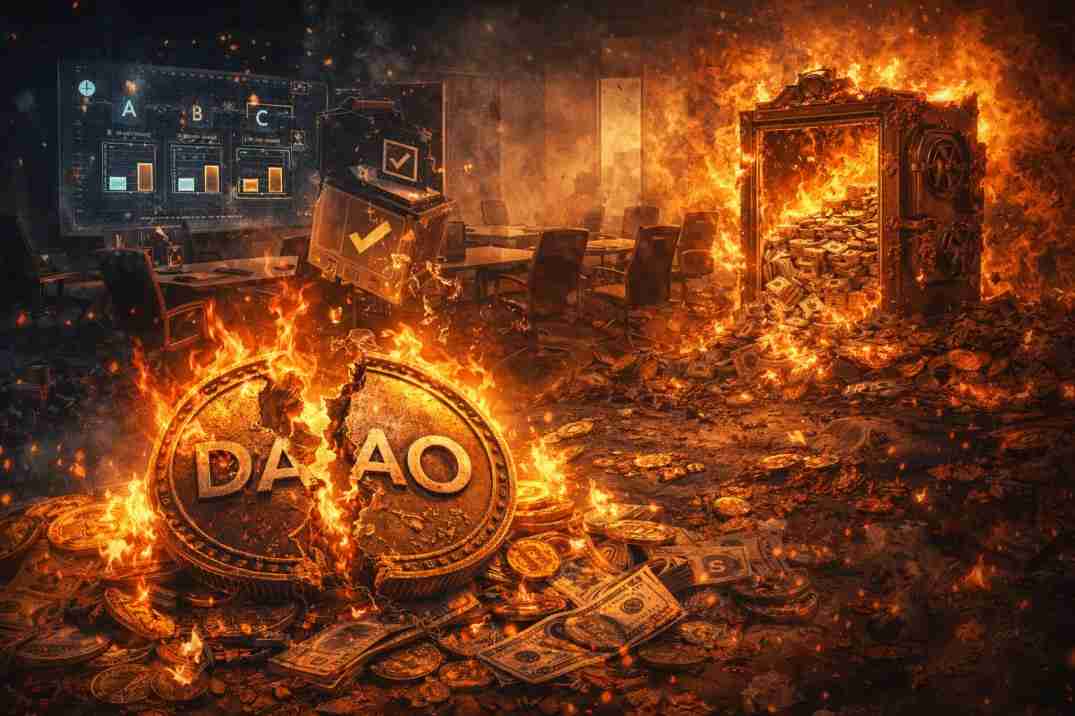
DAOs were going to be revolutionary: No more opaque boards and shareholder politics, just transparent, code-based collective decision-making. Initially, the picture was heady: communities pooling money into on-chain treasuries; voting on grants, bootstrapping public goods with no need for centralized trusts. But several years and many headlines later, a troubling pattern has emerged:
treasuries that were supposed to be the lifeblood of decentralized communities are quietly shrinking, getting drained, or becoming unusably illiquid, not because the code always failed, but because governance did.
This article delves into how DAO treasuries have developed, why token-voting often fails to govern the institutions it’s meant to govern – and yes, where it’s helped, offers specific examples of treasury breakdowns and provides real-world governance models that let treasuries at least put up a fight. The diagnosis matters: if DAOs continue to treat governance as an afterthought, treasuries will continue to wither, and with them, much of what made crypto communities promising in the first place.
The Evolution of DAO Treasuries: From Promise to Plateau
The early story around DAOs was simple and seductive: give the community tokens, let token holders vote, and have the majority steer capital towards productive projects. Treasuries grew fast. Protocols collected fees, token sales pumped liquidity, and decentralized grants or incentive programs were funded directly from on-chain balances. For a golden period, balance sheets ballooned, and a new form of community finance seemed possible. But growth didn’t translate automatically into sustainable stewardship. As treasuries ballooned, a set of practical tensions appeared:
- Scattered incentives: A huge chunk of token holders were just speculators, not caretakers. When what you want is for the price to appreciate in the short term, there’s not much incentive to engage in slow budgeting or long governance decisions.
- Centralized power: Behind the decentralization talk, tokens were always heavily skewed, and any distribution logarithmic in scale eventually came to be owned by a few big bangers who could swing the vote one way or another. This created a subtle version of centralized control that operated through token markets rather than corporate titles.
- Operational complexity: Treasury is hard; you need to think about risk management, law, GAAP accounting, diversification strategies for treasury, which are skill sets that few token-voter communities have at a scale necessary to manage a $1b+ balance sheet.
- Security and tooling gaps: On-chain treasuries expose funds to smart contract risk, oracle failure, and fast-moving market shifts. Without professional risk teams, treasuries are vulnerable.
The result is not a dramatic overnight collapse in every case, but a plateauing and, in many cases, decay: treasuries stop growing, funds are misallocated, or assets become trapped behind governance gridlock. The dream of a continuous, community-run endowment gives way to a more brittle reality.
Governance Failures: Why Token-Voting Alone Isn’t Enough
“Token holders decide” sounds democratic, until you look at how decisions actually get made. Token-voting, as a baseline mechanism, contains a few structural problems that directly undermine treasury health.
Low participation and apathy
Voting turnout in most DAOs tends to be extremely low. When only a small fraction of token holders participates, the will of the active minority, which may not represent the community’s best interests, becomes de facto governance.
Economic capture and vote buying
Because vote weight is proportional to token holdings, those with large balances can steer decisions. This creates perverse incentives: wealthy actors can purchase influence, coordinate off-chain deals, or engineer governance outcomes that favor their positions. Over time, that causes treasuries to be used for rent extraction rather than ecosystem building.
Short time horizons and tokenomics mismatch
Tokens traded on markets push many holders to prioritize price stability or one-time yield events. Long-term treasury stewardship, building public goods, and funding research lose out to proposals promising immediate returns or liquidity events.
Information asymmetry and governance complexity
Many governance ideas have been technical or subtle. Voters do not have the time or expertise to assess complex financial, legal, or technological risks, and so even sophisticated concepts are susceptible to bad actors or well-meaning misjudgments.
This set of problems isn’t hypothetical. Critics, including prominent protocol founders and major voices in the Ethereum community, have repeatedly warned that straightforward token-voting systems are easy to capture and hard to scale into robust institutions.
Taken together, these failures mean that treasury decisions often reflect the incentives of the loudest, richest, or most organized participants, rather than the long-term interest of the DAO’s mission.
Case Studies of Treasury Breakdown: When Governance Goes Wrong
Looking at real examples helps ground the diagnosis. Below are four illustrative episodes where governance choices, not just code bugs,s turned into treasury crises.
The DAO (2016): code, governance, and the fork
One of the earliest and most famous failures is instructive not only for its technical vulnerability but for how governance reacted. In 2016, an attacker used a re-entrancy bug to take most of The DAO’s money. The community was confronted with an agonizing conundrum: eat the loss or execute a blockchain hard fork to recover the stolen funds.
The choice to fork, to instead rewind the chain and refund lost funds, ultimately offset an immediate treasury loss, but it also split the community and prompted consideration of issues as fundamental to a trust-based economy as immutability, trust, and collective action in decentralized systems.
The event illustrated that governance choices (how the community responds) can be as consequential as technical failures.
SushiSwap (2020): the founder withdraws, community backlash follows
When the SushiSwap platform was unveiled, it grew its pool of liquidity quickly. But then dispute came when the anonymous co-founder “Chef Nomi” removed some dev allocations ($14M or so) from the protocol, sparking exit scam claims. The founder eventually returned the funds and turned control over to other developers, but the episode showed how centralized control of treasury keys paired with token-based governance without social moorings can inflict existential crises on a DAO. The social dynamics and trust, reputational incentives, and swift governance response mattered as much as on-chain mechanics.
MakerDAO and Black Thursday (March 2020): liquidation and hard trade-offs
MakerDAO, one of the first successful DeFi protocols, had its treasury and governance put to the test during “Black Thursday” as price crashes led to mass liquidations and a protocol loss that no one expected. The governance body argued around compensation and risk parameters, decisions that affected the treasury of the protocol’s surplus and long-term credibility. That incident underscored the need for governance bodies to operate quickly and wisely in times of stress, as well as how disjointed approaches to emergency protocols can turn market volatility into irreversible damage for a treasury.
OlympusDAO and the sustainability problem (2021-2022)
OlympusDAO developed a new treasury-backed token model: bonding and staking to grow on-chain reserves, with incentives for participation through arcane tokenomics. During the peak of 2018, OHM’s story simply made sense to the market, but as time went on, seeing OHM come crashing down from its highs forced people to reflect: Does the treasury model work? Is there enough governance in controlling economic design? The Olympus tale is instructive because it demonstrates how ambitious treasury arrangements can self-fuck if governance doesn’t vigilantly handle reserves, risk, and incentives, especially when a sizable chunk of users are speculation junkies who lust after outsized yields.
Additional micro-failures: tooling and code incidents
Beyond headline disasters, numerous smaller incidents, like pool bugs, oracle failures, and fund freezes, have trapped or jeopardized treasury assets when governance lacked clear emergency or mitigation paths (e.g., the Fei Protocol launch issues where an incentivized pool became unusable and value locked). These are just the latest in a long line of such incidents; treasuries don’t fail only because some external market shock creates a liquidity crisis, but also when governance is haphazard and unclear, or there is insufficient expertise on hand.
Reimagining DAO Governance: Beyond “One Token, One Vote.”
So if token-voting is fragile, what now? Restoring the health of the treasury will require moving from naive majority rule to a layered, resilient governance that combines incentives, expertise, and accountability.
Delegation and representative models
Rather than expect millions of retail holders to weigh in on every technical decision, DAOs can enable thoughtful delegation: token holders can delegate to trusted, accountable stewards who handle the voting on their behalf. Fundamentally, delegation must be free-flowing and reversible; people should delegate based on outcomes and be subject to a recall vote. It is a mixture that minimizes voter fatigue and maintains sovereignty.
Quadratic, conviction, and hybrid voting
Alternative voting systems can reduce the power of whales. Where quadratic voting minimizes the marginal power of financial whales, conviction voting amplifies enduring preferences over up-to-the-minute capital. These mechanisms are not silver bullets, but they alter incentive structures and make centralized capture more costly.
Multi-layer governance (operational vs. strategic)
We can break governance into two distinct parts. Big, strategic decisions, the stuff that really shapes where we’re going, can be handled by token holders or a larger group. But for the everyday work, like managing our money, a smaller, trusted team that’s been checked out and has clear instructions would take care of that. If we want operational squads to keep moving without needing a full-DAO vote all the time, they really need to be open about what they’re doing. This means clear reporting that everyone can see. We also need to set some strict boundaries, like spending caps and multi-sig withdrawals that are locked for a certain time.
Time locks, multisigs, and on-chain guardrails
Technical safety nets such as timelocks, distributed key holders for multisig wallets, and automated threshold rules (e.g., emergency pause functionalities) allow the community to have sufficient time to respond to suspicious operations.
Institutional partners and insurance
DAOs can also hire professional treasury managers, custodians, or decentralized insurers to manage liquidity and risk. This does introduce some centralized aspects, yes, but deployed with intention and transparency, they can protect assets while the community matures its governance muscle.
Civic processes: audits, independent reviews, and dispute resolution
Put regular, outside audits in place, published Treasury reports, and independent review boards (with a rotating membership) to look at spending. On-chain courts or a formal arbitration process, or an off-chain arbitration with on-chain enforcement, grant the DAO structured means to settle disputes away from ad-hoc mob reactions.
Evolving norms and reputation mechanisms
Finally, culture matters. Such protocols that grow reputational incentives (e.g., offline reputation, contributor portfolios, proof of delegate performance) can mitigate these risks of governance attacks. Reputation systems, if well-designed and resistant to gaming, can complement financial incentives.
These reforms are achievable, but achieving them requires tough tradeoffs. Every new mechanism adds complexity as well as another potential point of centralization, and so the trick is to choose a mix that protects treasury health without betraying our core commitments to decentralization.
Conclusion
DAO treasuries did not perish from a single bug or a single scandal. They are rotting away in slow motion, as resources are squandered and conflicts emerge over the rules of engagement.” They’re suffering a silent atrophy born of misaligned incentives, ill-designed institutions, and governance mechanisms unengineered for the real world.
From The DAO’s early, painful lessons about code and collective choices to later episodes like SushiSwap’s founder controversy, MakerDAO’s liquidation stress, and OlympusDAO’s economic challenges, the pattern is clear: governance, not technical novelty alone, determines whether a treasury becomes an enduring public good or a fragile pile of assets.
The encouraging news is that the way out is not only visible. It is neither mystical nor purely technical: Jumper treasuries will be built with better incentive design, antifragile voting systems, clear operability roles, professional risk practices, and fully internalized social norms that reward sustainable stewardship. Those answers demand honesty (about the limits of “one token, one vote”), craft (in designing hybrid systems), and humility (acknowledging that governing is hard).
If DAOs are to rise up and fulfill their potential, funding public goods, maintaining open projects, and activating community-driven economies, they cannot treat governance like a check in the box anymore. Treasuries are more than just wallets; they’re institutions. We will protect them with institutions that merge cryptographic transparency with social accountability, economic realism, and operational competence. Only then will the silent death be undone, and DAO treasuries will become alive, antifragile pools of capital for the communities they support.