The current world has seen the domination of a small number of big companies in terms of physical infrastructure such as internet networks, power grids, and data storage.
Such centralization is frequently costly, hard to access, and without much user control. That is where DePIN comes in, or Decentralized Physical Infrastructure Networks.
The new strategy DePIN uses blockchain and the power of communities to create real-world systems on a more even fair. It is fast becoming a hot debate in the Web3 space where people desire greater freedom and control.
What is DePIN, how does it work, examples, pros, cons, and the future? Let us take a look.
What is DePIN and Why Does it Matter?
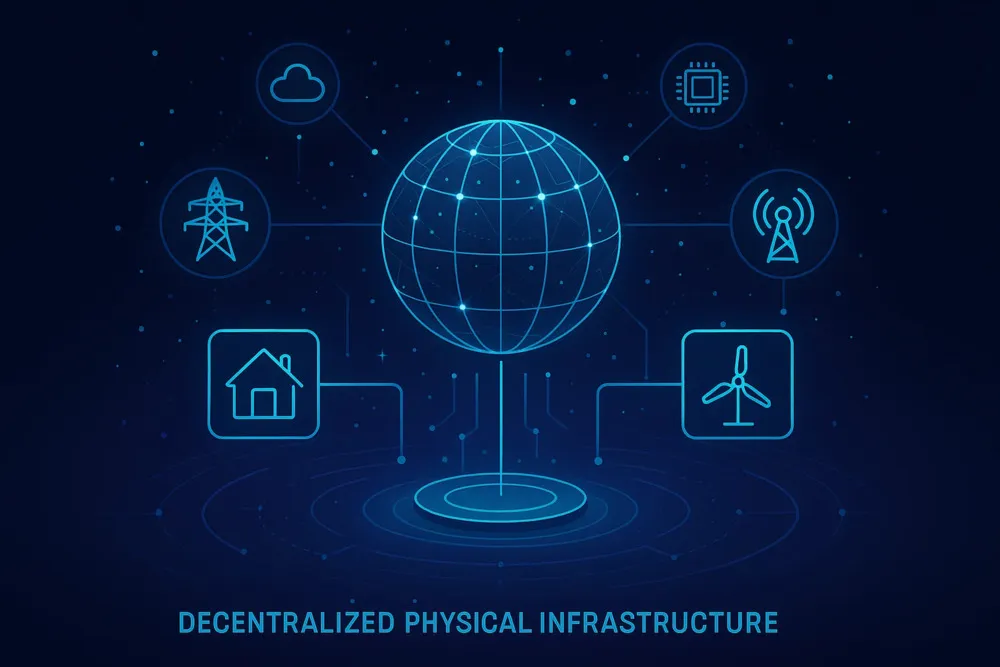
DePIN stands for Decentralized Physical Infrastructure Networks. It is a new way of building and operating physical infrastructure in the real world like internet, storage, energy, and mapping on the basis of blockchain technology and community involvement.
These networks run on individuals who contribute devices, data, or resources and are rewarded with tokens, instead of being controlled by big companies.
The Shift from Centralized to Decentralized Infrastructure
In traditional systems, infrastructure is owned and operated by governments as well as large corporations. This is referred to as centralized infrastructure. Since it offers stability, it is usually expensive, the accessibility in the rural areas is minimal as well as the control of the user.
DePIN goes in another direction. It gives anyone an opportunity to join the system by sharing their data or hardware. This makes the network open, flexible, and fair in a special way to the communities that are usually left out.
Comparison with Traditional Infrastructure and Web2 Models
In Web2, all is controlled by Facebook, Google, or Amazon, and they earn money on the activity of users and their information. The consumers have minimal control and ownership.
As a component of the Web3 movement, DePIN reverses this model. Today, users are no longer consumers, but contributors, and owners of the network. They contribute to its building and are rewarded for doing so.
Importance of Decentralization in Solving Global Issues
DePIN allows it to address key issues such as inaccessibility, high service prices, and concentration of power by distributing control among a large number of individuals.
It provides services to rural areas, reduces expenditure, and provides more independence to the users on the global level.
How Does DePIN Fit into the Web3 and Crypto Movement?
Web3 is about decentralizing powers.
The application of this idea into practice is realized with the help of DePIN. It combines blockchain and real-life infrastructure that allows everyday citizens to participate in the build and operation of networks that were previously beyond their reach.
This is the reason why DePIN is a big part of Web3.
How DePIN Works?
Physical Hardware Layer
All DePIN projects begin with real-world hardware. This may be routers, sensors, hotspots, dashcams, GPS trackers, or miners.
These devices are installed by people in their homes, cars, or jobs. As an example of a decentralized wireless network, in Helium, users can install small hotspots that offer internet coverage to nearby devices.
Blockchain Layer
In the background, DePIN projects operate on a blockchain. This layer handles such significant operations as smart contracts, record keeping, and consensus mechanisms.
The blockchain is a way that makes sure that any action like the provision of service or data contribution is recorded safely and authenticated by the network.
Smart contracts reduce the need for a middleman to execute tasks such as rewards, penalties, and data tracking in an automated manner. This builds credibility and makes the system open.
Tokenomics and Incentives
DePIN rewards the people who join the network using crypto tokens to encourage them to join and support the network.
The system rewards a person with tokens when someone runs a hotspot or adds useful data. The tokens are valuable in the real world, as they can be bought or sold in the network.
Such an incentive system helps in the growth of the network and its coverage across more areas, particularly those that are not covered by traditional infrastructure vendors.
Example in Action – Telecom or GPU Networks
The hotspot in a telecom DePIN system like Helium increases the coverage range and rewards each user. On GPU-based systems such as Render, people contribute their unused graphics processing capabilities to render tasks and collect tokens as payment.
On-Chain Validation
Whenever a user contributes, the blockchain records the action, validates it using a consensus mechanism, and rewards the user.
This mechanism maintains the network fair, secure, and self-sustainable.

Real-Life Use Cases of DePIN
DePIN is not a theory, but it is already in practice.
Here are some of the best projects and how they address the daily problems using decentralized infrastructure.
A) Helium Network – Wireless Coverage and IoT
Helium Network is a decentralized wireless system. Rather than use large telecom corporations, Helium allows people to install tiny hotspots that can cover Internet of Things (IoT) devices such as sensors, pet trackers, or smart meters. The users in return, earn the Helium tokens (HNT).
This helps in reaching out to areas that the traditional telecoms do not reach due to focus on high-income areas or rural areas.
B) Render Network – GPU Power for Creators and AI
The Render Network also enables people with unused GPU (graphics processing unit) resources to share them with others in need.
This involves video editors, the development of AI, and digital artists. Creators can pay RNDR tokens to use the network of Render instead of purchasing expensive cloud services. Providers who offer GPU power get these tokens as rewards.
It is cheaper, quicker, and more accessible than the conventional GPU services.
C) Hivemapper – Map Building with Dashcams
Hivemapper is a mapping platform that is decentralized. Drivers mount dashcams in their cars and record videos of the roadways.
This video contributes to the creation of a global real-time map.
The contributors are rewarded with HONEY tokens. As compared to Google Maps, where the company owns the data, Hivemapper provides users with an opportunity to become both the owner and earn a profit through maps they contribute to.
D) DIMO – Car Data Sharing for Smart Mobility
DIMO allows car owners to safely post their vehicle information, like fuel consumption, speed, and GPS, using blockchain. Such information is useful to carmakers, app developers, and insurance companies.
In exchange, car owners are rewarded. The project supports innovation in the automotive world and puts drivers in charge of their data.
E) Filecoin and Akash – Storage and Cloud Computing
Filecoin enables users to lease unused hard disk space to store files. Akash Network is a decentralized cloud computing provider.
Such services are cheaper and less dependent on giant tech companies such as Amazon Web Services or Google Cloud.
All these projects address existing issues and prove how DePIN promotes affordable, open, and community-owned infrastructure.
How Crypto Incentivizes Real-World Infrastructure Building?
Rewarding Participation with Tokens
Among the primary reasons DePIN projects so quickly is because they reward users with crypto tokens.
When someone shares their internet connection, GPU power, data, or storage, they earn a project native token, like HNT in the Helium project, RNDR in the Render project, or HONEY in the Hivemapper project.
Such tokens may be traded, but also stored, or consumed on the network.
Proof-of-Work Done in the Real World
DePIN has special models that are used to record and reward useful work.
For example,
- A Proof-of-Coverage (Helium uses this) verifies whether a hotspot is actually delivering wireless coverage.
- Proof-of-utilization (rendered with Render) monitors the use of GPU power. These models ensure that only users who will be able to contribute true value to the network will be rewarded.
Kickstarting Growth in Underserved Areas
In the traditional systems, it is costly and in most cases, the new infrastructure is overlooked in the remote or poor regions.
By using DePIN, crypto rewards are appealing to users anywhere, thereby extending services to areas where it is needed most without having to wait for big companies.
Attracting Passive Income Seekers
The main attraction of DePIN is the opportunity to make passive income which many people find attractive.
Once someone installs the necessary hardware, they can earn tokens regularly simply by maintaining it.
To the tech-savvy user, it is a simple method of making money and supporting decentralized expansion.
Top DePIN Projects to Watch
How to Identify Leading DePIN Projects?
Considering some of the best DePIN projects, one should pay attention to the following,
- User base: the number of users using or contributing actively
- Innovation: The uniqueness or use of the idea is
- Growth potential: Is the project growing and addressing real-life issues?
These are 5 projects that stand out as we head to 2025.
- Helium Mobile – Decentralized 5G Network
By entering into the 5G mobile industry, Helium Mobile is increasing the Helium Network. It allows everyday users to host 5G hotspots that provide mobile phone coverage.
This could reduce the need for big cell towers and ensure that users have more control. Helium Mobile is now serious in the telecom industry due to its recent deal with T-Mobile.
- Render Network – GPU Power for AI and Graphics
Render is still expanding as it offers cheap GPU power to AI developers, video editors, and 3D artists.
As the demand for AI tools increases, Render is a cheaper alternative for those who cannot invest in expensive hardware. Its decentralized structure makes access to GPU fair and transparent.
- DIMO – Connected Car Data
DIMO allows people to gather and distribute vehicle data through blockchain.
The project is collaborating with real car manufacturers and developers, which is what makes it one of the most practical DePIN use cases in the automotive sector.
Connected mobility DIMO can be a part of connected mobility as cars become smarter.
- Hivemapper – Building a Global Map
Hivemapper is creating a decentralized Google Maps. Drivers are using dashcams to capture data on the road and earn tokens.
What we have is an up-to-date crowd-sourced map, not owned by a corporation.
- WeatherXM – Community-Based Weather Stations
The WeatherXM enables people to set up local weather stations, and they can receive rewards by sharing weather data.
This enhances predictions, particularly in rural or underserved areas.
All these projects indicate how DePIN can expand through solving actual problems and giving rewards to real people.
Risks and Scalability Challenges
As much as DePIN has a lot of advantages, there are also a number of risks and challenges that it encounters particularly as it expands.
Both users and investors should know these issues.
Technical Risks
DePIN is based on physical hardware like sensors, hotspots, and dashcams. Such devices may be broken, worn off, or require upgrading.
If users fail to take good care of their hardware, the network can experience downtimes, low coverage, or inaccurate data.
When dealing with vast networks all this hardware is more difficult to control.
Economic Risks
The vast majority of DePIN networks reward the users with tokens. However such tokens may also lose value because of market fluctuations.
In case the token prices decrease, users will not find it worthwhile to continue operating devices.
This poses ROI (return on investment) uncertainty and this may discourage new participants.
Security Concerns
Since DePIN is open to all people, there is a possibility of bad actors manipulating the system.
For example, a user might attempt to cheat by creating dummy nodes or bots to get rewards, these are called Sybil attacks.
DePIN projects need to build powerful systems to identify and prevent abuse.
Legal and Regulatory Issues
There are cases where DePIN networks may be in areas that need special licenses to operate such as telecom or data services.
In the absence of clear laws, few projects can be in legal trouble. User data privacy is also a concern, particularly where networks are collecting GPS, video, or sensor information.
Environmental Concerns
Massive deployment of devices may lead to more electronic waste and energy consumption. Otherwise, the physical development of DePIN has the potential to destroy the environment.
DePIN is strong, yet to become safe and sustainable, these risks should be well managed with smart design, clear regulations, and community awareness.
The Future of DePIN – What’s Next?
Smarter Integration with AI and IoT
DePIN, in the future, will probably collaborate more with AI, edge computing, and Internet of Things (IoT) devices.
This will faster to quicker data processing and intelligent networks and improves real-time services such as traffic information, energy management, and smart cities.
More Interest from Big Companies
With DePIN becoming worthwhile, big businesses and organizations are beginning to take notice.
Telecoms, energy providers as well as even governments are considering the development of partnerships with DePIN projects to lower costs and reach more people.
Cross-Chain and Token Interoperability
Multi-chain support is another exciting thing that is coming.
Soon, DePIN tokens can be used on various blockchains, and this aspect is more practical and convenient to trade. This provides access to more users and better liquidity.
Partnerships in the Real World
More deals with automakers, telecom services, as well as city planners are to be expected, and DePIN will be able to grow at even greater speed to offer real services that people use daily.
Bottom Line
DePIN is also growing as an important part of the Web3 movement, providing an alternative approach to building and administering real-world infrastructure.
It allows communities the opportunity to build networks that are more open, affordable, and fair, replacing the old ways of depending on large companies.
DePIN projects are already changing things, whether it is wireless coverage, GPU power, and mapping.
This model may revolutionize the way we connect, share, and build, as more individuals and corporations become a part of it.
DePIN is not only a new concept, but also a real revolution in the world, and a great chance for those who want to be part of the future.