Web3 is transforming the way people use the internet. Such technologies as blockchain, NFTs, and crypto tokens are already impacting finance, art, and games — with NFTs evolving beyond art into real utility. They are also appearing in social applications. People are developing niche sites that together users share similar interests, and dating is not an exception.
Niche dating apps have become common in recent years, including those based on pets, gaming, or hobbies. Web3-only dating apps go even further by using wallets, tokens, and membership badges to connect people who share a crypto-centric mindset.
Some users appreciate these apps for providing more authentic matches and a sense of belonging, while others worry that they may be too exclusive or risky.
Let’s discuss how Web3 dating applications perform, why they are appreciated by some users, and what issues occur.
The Evolution of Online Dating
A) Quick history
Online dating began with simple websites in which people completed profiles and awaited messages. Then there were apps such as Tinder and Bumble that could match quickly and easily in swipes and brief biographies. The apps transformed the way people meet, as it became easy to find a lot of potential matches in a short time.
B) Shift to niche apps
Following the expansion of the large general apps, creators built niche platforms for particular groups. Pet lovers, gym fanatics, specific religions, and plenty of others have their apps. Niche apps help people in finding others who share similar values or hobbies, usually it is easier to make a conversation and meetings are more natural.
C) Move toward crypto communities
Some dating apps started using those connections to match people as blockchain, NFTs, and token groups expanded — often leaning on the same AI-driven matching and analytics used in crypto trading. Shared interests or proof of belonging to the same community can be a wallet, a token, or a membership badge. To some users, that helps in finding users who share the same language when it comes to crypto. To some, it may be too exclusive or status oriented.
Crypto dating has a clear path: simple websites, mass market applications, niche apps, and currently niche applications based on new technology.
Web3-Native Dating Platforms
A) Existing platforms and ideas
Other dating projects are built entirely on Web3 concepts, whereas others implement crypto functionalities into existing applications. Imagine token-gated communities in which you require a particular NFT or token.
Some versions of Aisle and Lox Club and a handful of more popular niche apps, have experimented with how to introduce wallets and tokens to dating too.
These examples show the different directions: fully Web3 applications, which would make use of a wallet, and hybrid applications, which would provide optional crypto benefits.
B) How do wallets, tokens, and blockchain verification work?
A wallet is a digital ID which displays what tokens or NFTs you own. It is possible to add a wallet to Web3 dating apps and prove that a person is also a member of this community or a DAO.
NFTs or tokens can serve as membership badges, and the ownership of one of them can unlock a profile or a private chat room. The verification of blockchain means the application will be able to verify ownership without inquiring about sensitive personal information.
Often, what is uploaded is a photo ID, but instead, you can have a token transferred or a signed message verified in your wallet.
C) Benefits of decentralized systems: security and transparency
The major advantage of decentralization is that it is transparent; blockchain records can indicate the ownership of a token in an account, and this can reduce fraudulent accounts that claim to be members.
Security can also be made better, since not all apps store private data on a central server. When properly managed, users have more control of their information.
D) Benefits of exclusivity
Web3 dating is also about exclusivity. The token-gated spaces form tiny, like-minded groups in which the members already have an interest in crypto.
That can create better, faster connections since people have a shared point of starting to discuss.
E) A quick caution
Good design is required for these benefits. In case even a platform leaks wallet history, or tokens come to be the primary target rather than real people, the benefits may become a problems.
The dangers will be examined in the later sections and how to identify those platforms that use Web3 in a good and efficient manner as opposed to those that use it only for show.
Matching by Wallet Activity and Token Affinity
A) Matching by crypto activity
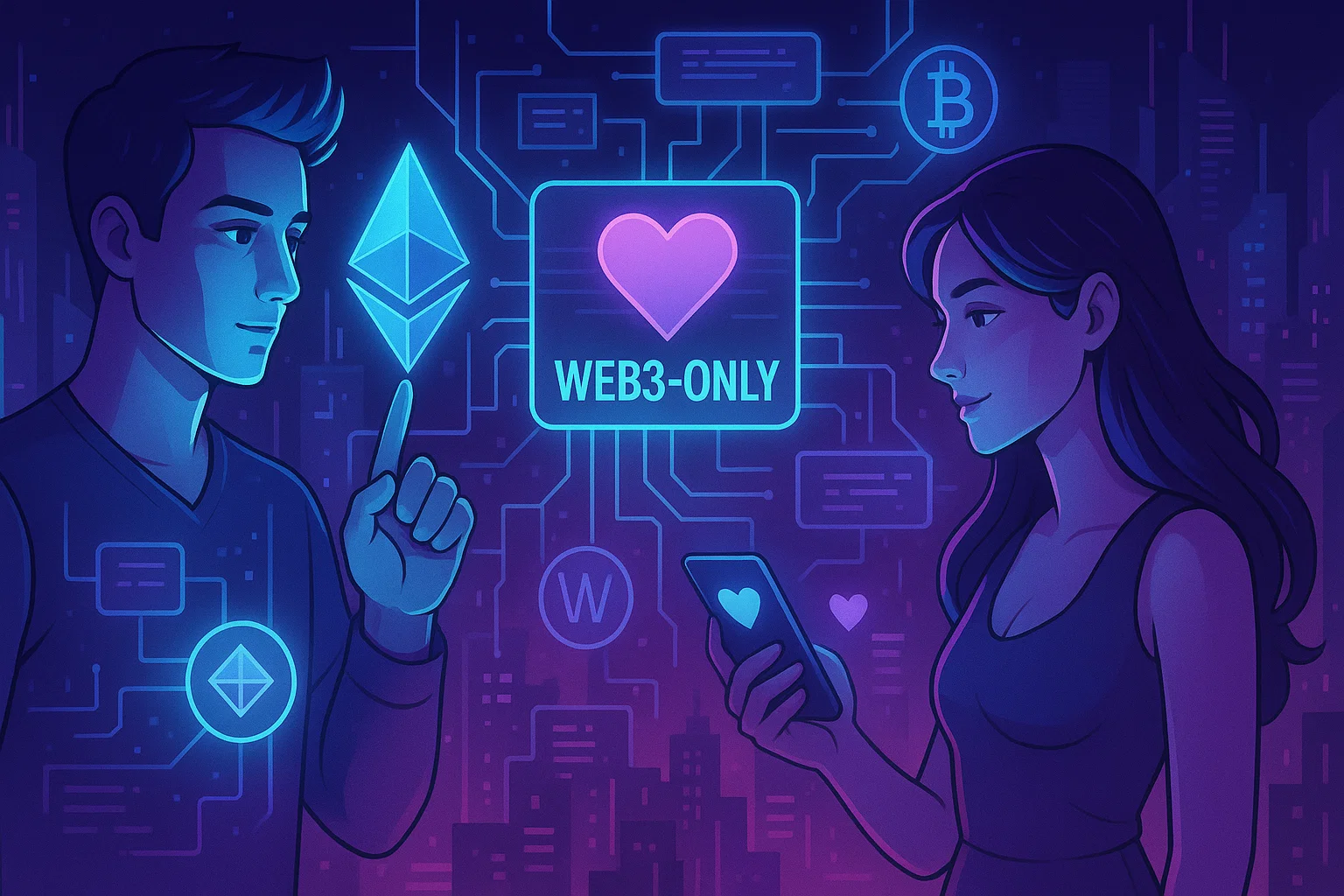
There are also Web3 dating apps that try to pair users by their wallet activity rather than or in addition to likes and bios. The concept is easy to understand.
When two people own the same NFT or are members of the same DAO, they may have similar interests and values. That can help to get matches who already “get” crypto.
B) Wallets as a digital ID and interest marker
A wallet is a micro-app with your crypto and NFTs stored. A wallet can perform the role of a badge in these dating applications. Rather than listing out hobbies, your wallet indicates the communities you are in, the tokens you get, and the projects you sponsor.
To lots of users, that gives you an immediate hint that you belong to a particular group, you subscribe to the same projects, or you subscribed to a particular group of creators.
C) Matching by NFT communities, DAOs, and tokens
There are a variety of ways matching can happen. The app is able to see whether you share NFTs within the same collection, within the same DAO, or with fellow tokens. It can then propose individuals who are highly overlapping those holdings.
Other platforms also allow you to filter by, such as only match with members of a particular NFT club. This forms a focused pool in which discussions can be started based on a common interest.
D) Privacy and data concerns
At the same time, wallet-based matching raises real privacy questions. The activity of Blockchain is transparent: every user can monitor what addresses contain what tokens.
It can be a lot connected to a personal profile by linking a public wallet and revealing purchases, memberships, and even financial flows. That can result in unwanted notice or judgment of spending.
Risk can be reduced, for example, by using a new profile wallet or by proving membership without revealing full history, such as signing a message. Good applications should offer clear privacy options and make it easy to see what information others can view.

The Appeal of Web3-Only Dating
- Shared interests and language
The advantage of having a membership is that members already have something in common as a hobby or a way of thinking. When a person is a collector of NFTs or a member of a DAO, he or she is aware of the jargon and the culture.
That simplifies first messages. As opposed to unnatural small talk, participants can begin with a mutual project, an NFT release, or a vote in a DAO.
- Trust and transparency through blockchain
Blockchain will be able to provide an easy method to authenticate membership or actions without requiring personal documentation. An example of this is having a certain token that behaves like a club card.
This will reduce fake accounts in the case that the application verifies token ownership. When used correctly, these checks provide users more confidence that others are real members of the same community.
- Early-adopter exclusivity
A good number of people enjoy being involved in something new. Early adopters of Web3 dating can also like working in tight groups. That exclusivity is exciting and can be used to build stronger bonds within a short period of time.
To some users, it is entertaining to come across other people who had been early supporters of the same projects.
- How does it foster deeper niche communities?
Due to the fact that these apps are linking people sharing an interest in crypto, people have a more in-depth conversation. Members do not have surface level conversations, but discuss roadmaps, art drops, or governance.
It can result in meaningful connections. Group events, AMAs, or personal meetups in token-gated spaces also allow the community to grow offline as well.
- A note of balance
These prizes are real but only effective when platforms are concerned with tokens. With the app maintaining high safety checks, privacy settings, and community policies, it can become a place of true friendships or relationships as people share common crypto interests.

Challenges and Red Flags
- Bots, scams, and NFT flex culture
One big trouble is a fake or automated account. Bots can pretend to be actual users and send the same message to a large number of people. Others are used to test reactions and others to scams.
Next is the NFT flex culture in which profiles display costly tokens as a means to impress. That can push discussions to status and money, and not a genuine connection. That is also used by scammers to be trusted.
- Fake profiles and rug-pull dating scams
Rug-pull scams are those in which a person develops trust and then withdraws money or disappears. A scammer in crypto dating may pretend to be someone else in the collector or DAO group or request assistance with a personal sale, get you to sign or agree to a contract.
When you sign a bad contract or send money, it is not always easy to recover. It is also usual to find fake profiles, which copy photos and bios, and since there is a possibility of people talking with no one on the other end.
- Too much focus on wealth signaling
The presentation of NFTs or token balances can make the space shallow. People, rather than getting to learn about values and personality, can base their judgment by what they own. That gives bad behavior, such as telling lies about making purchases or entering unstable deals in the name of showing off.
It is also attracting those people who are primarily concerned with profit rather than relationships.
- Lack of verification and weak moderation
Most of the early Web3 apps lack strong checks of a real identity or good moderation team. Bad actors multiply in the absence of a clear set of rules and active control.
Reporting applications, manual audits, and trusted verifications are useful, but they can be expensive to execute. Applications that do not take these steps expose users.
- Security risks from linking wallets and personal info
Linking your primary wallet to a dating account can tell anyone who looks into the wallet what you bought and what you hold. That is a privacy risk and can cause doxxing or unwanted attention.
Worse, fraudsters might request you to sign financial transactions that transfer funds or sign contracts. You should never give out your seed phrase or sign deals transferring money unless you understand the reason and to whom. It is safer to use another profile wallet with lots less money and no personal information attached.

What’s Legit vs. Just for Clout
A) Separating real platforms from the hype
Not every Web3 dating application is long-lasting. Some launch with much buzz and disappear after a few months.
Others are simply working on creating attention, and not a safe and useful platform. As a user, it is important to understand what a real project is and one that is driven by hype.
B) Signs of trustworthy platforms
A serious Web3 dating app usually shows clear signs of planning and effort. Look for applications that are highly secure, such as encrypted messaging and secure wallet connections. Ensure that they are actively developed, i.e., periodically updated, have bugs fixed, and new features added.
Community feedback is another indicator that things are going right; the apps that listen to their users and maintain open communication form a stronger trust. More reliable teams are also those that are open, sharing their ambitions and road maps.
C) Hype-driven projects
On the other hand, some platforms are built just on clout. They are also promising high growth rates, display flashy NFTs, and prioritize marketing over value creation.
The security of these apps is usually poor; there is no actual support team, and these teams are difficult to check. The large majority of them have a short lifespan after the excitement has been lost.
D) Sustainable growth examples
Platforms that last usually grow slowly but steadily. They do feature testing, safety tools investment, and real user base building.
Their attention to quality and trust might not make them have the largest communities immediately, but their concentration makes them remain with time.

Conclusion
Web3 dating combines technology with connection and is based on exclusivity and transparency, but is at risk of scams and privacy problems.
It is still a niche, but these platforms have a chance to expand with more secure conditions and genuine community orientation. Whether crypto dating will stay niche or become mainstream is to be seen in the future.